
Dmitri Dozortsev (if you like to become co-contributor, please contact me on linkedin)
Definition
Post-mature oocyte is an oocyte that exhibits signs of intrafollicular degeneration and may be at GV, MI or MII stage at the time of recovery from the ovary.
Origin
Post-mature oocytes are usually found in patients with well suppressed LH, which indicates that they are the result of local and not systemic factors. The absence of systemic influence can further be substantiated by observations that only a single egg (or at least minority of eggs) in the retrieved cohort will have the features of post-mature oocytes, whereas systemic factors would be expected to result in post-maturity of the majority of eggs. The cumulus of post-mature oocyte is also distinctively different from that of normal oocytes with follicular cells having a distinctive degenerating morphology.
P4 in patients with post-mature egg is often elevated, sometime considerably and disproportionately to the number of the follicles. Under normal circumstances, each follicle toward the end of follicular phase contributes about 0.1 pg/L to the level of systemic progesterone. It would therefore be expected in a patient with 20 follicles to observe progesterone level of about 2 pg/L. However, in patients with post-mature oocyte, P4 level can be as high as 12 pg/L in the presence of only 4 or 5 follicles.
Post mature egg-cumulus complex (left) next to normal egg-cumulus complex:
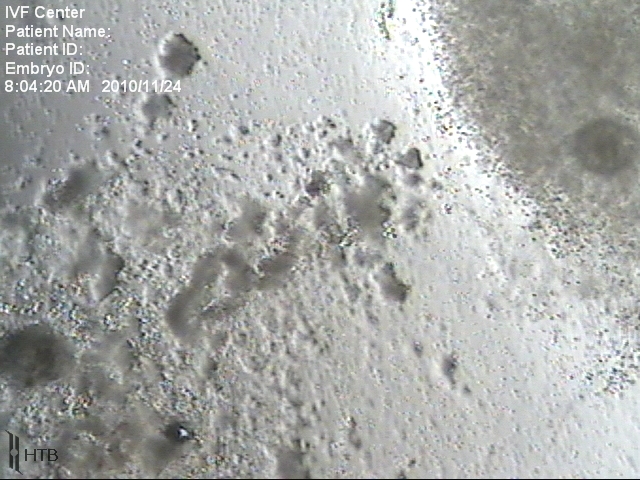
Post-mature eggs (right) next to normal egg:

Under normal circumstances, the resumption of meiosis is triggered by LH surge which results in the degeneration of gap junctions through which meiosis resumption inhibitors are continuously delivered into the oocyte from corona cells. However, the resumption of meiosis can also be triggered mechanically removing corona cells which will eliminate the effects of meiosis inhibitors.
In the case of a post mature egg, it is apparent that a catastrophic event caused the degeneration of the corona cells and this was the most likely pathological trigger for the resumption of meiosis (if the egg was primed) or degeneration without the resumption of meiosis (if egg was not primed). In the vast majority of cases, post mature eggs are sufficiently primed and will resume meiosis.
The cytoplasm of post-mature eggs, by its appearance and by stretching properties during ICSI, resembles the cytoplasm of unfertilized oocytes that were left in culture for about 2 days. Therefore, it is reasonable to speculate that catastrophic event takes place about 2 days prior to hCG. Since this follicle was ready to resume meiosis about 2 days before hCG, it is further reasonable to speculate that this was one of the leading follicles.
In summary, a local (follicular) catastrophic event in one of the leading follicles that takes place prior to hCG administration results in degeneration of cumulus cells, which leads to the resumption of meiosis in the oocyte that will have post-mature appearance at the retrieval.
It is important to note that the affected follicle itself apparently persisted (since it could be aspirated), despite its content undergoing degenerative changes.
Link between premature luteinization and post-mature egg
The cumulus of post-mature oocytes exhibits signs of apoptosis rather than luteinization and usually only a single egg in the cohort is affected. Therefore premature luteinization, which is caused by systemic factors can be ruled out, particularly because the premature elevation in LH is usually not observed in such patients. While the level of LH in these patients is normal, P4 may be elevated due to luteinization of some granulosa cells within the follicle with premature egg. This luteinization is spontaneous and apparently LH independent. Its mechanism is likely similar to the one described in hypophysectomized rats, where it was caused by FSH administration alone. It seems to be reasonable to speculate that some follicles in the human ovaries exhibit unusual sensitivity to FSH, which leads to premature luteinization.
Alternative trigger for premature luteinization
Even though it seems to be well established that LH is always a trigger of oocyte maturation, there is a host of compelling evidences that ovulation (at least in the natural cycle) may in fact be triggered by Progesterone. At the first sight, such scenario seems impossible, since P4 synthesis requires luteinization of granulosa by LH first. However, there is another, LH - independent source of P4 that is often overlooked - adrenal gland. This extra-ovarian progesterone could be responcible for triggering premature maturation in some sensitive follicles leading to appearance of post-mature egg. This would also explain persistence of a relatively high systemic progesterone levels in some patients with post-mature egg, despite an apparent death of granulosa cells and low P4 levels within such follicles (unpublished data). However, this alternative mechanism of origin of post-mature eggs, does not explain an apparent death of granolosae cells, which itself is the most likely candidate for a premature triggger of oocyte maturation.
Possible link between premature luteinization and "vanishing follicles"
Vanishing follicles - follicles that spontaneously disappear during ovarian stimulation is a well established phenomenon. It is particularly common in older patients, even though this may simply be due to the fact that in older patients it is easier to observe since the total number of follicles is small. In simple terms, those vanishing follicles simply "pop" when they reach a certain size, without any apparent help from any systemic hormones. This creates a possibility that they "pop" for simply mechanical reasons. Indeed, during the follicular phase, the volume of the follicle increases about 10 times. The surrounding tissues have to exhibit a considerable elasticity to accommodate such expansion. Furthermore, since the follicle is "local", its expansion can be affected, for example, by ovarian scars from prior ovulations. Also, elasticity can vary from site to site and is probably lost with aging. Also, elasticity would be expected to vary from patient to patient.
Therefore, it is possible that some follicles are originate from the area of the ovary where elasticity is lower and as its limit is reached, the follicle pops completely or, may loose its blood supply, in which case it would not pop, but persist, while its content, granulose cells dies, triggering pathological oocyte maturation.
Since post-mature oocyte is apparently a local event, triggered at the level of follicle, it is only affecting the potential of post-mature eggs, but no other eggs in the cohort.
Preventing premature luteinization and postmature eggs
http://www.ncbi.nlm.nih.gov/pubmed/18191330