
Section moderator: Dr. Gianpiero Palermo
This Embryobit is a part of the Assisted Fertilization chapter.
Content (contributed by Dr. Dmitri Dozortsev and Dr. Michael Reed
Testicular biopsy, fine needle aspiration, and microdissection of individual tubules can yield motile, viable spermatozoa for ICSI. Identification of viable sperm in a homogenized tubule preparation requires sorting through the multiple cell types common to testicular tubules to find the most appropriate sperm cell for injection. Sperm cells are selected first for motility, and secondarily for morphology. Testicular sperm are immature, and motility may be manifest as slow or rapid non-progressive twitching, and on occasion, motility with forward progression.
Identification of sperm cells in the preparation is easier when sperm cell density, a reflection of spermatogenesis, is normal across the bulk of the testes tissue; however, there are instances when spermatogenesis not consistent across all tubules, where the tissue will exhibit a mosaic pattern of tubule morphology. Individual tubules can be evaluated in this case during microdissection, or alternatively, the testicular tissue may be mapped, using a grid approach, by multiple fine needle aspirations to locate individual foci of spermatogenesis, after which the specific regions of spermatogenesis may be explored further. Individual tubules that are more likely to have sperm-containing regions would be larger in diameter and opaque, compared to regions without active spermatogenesis, and there is a greater probability of spermatogenesis in tubules nearer to a blood supply.
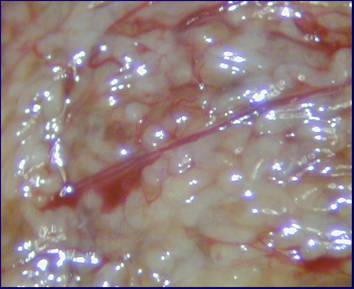
Close up view of testicular tubules and blood supply to tubules; in situ
Testicular tissue can be retrieved on-site near to the IVF laboratory, or off-site and transported to the IVF laboratory. Additionally, the tissue can be collected the same day as the oocyte retrieval, or prior to the oocyte retrieval and held in culture overnight for example, or cryopreserved and stored in liquid nitrogen until needed.
Testicular tubules can be processed using a variety of techniques. Although time consuming, individual tubules can be ‘milked’, where tubules are visualized under a dissection microscope, and a non-cutting instrument, the rounded edge of a glass pipette or a glass slide, for example, is pushed down and long the length of the tubule, pushing the contents of the tubule out of one end, and repeating this process as needed. Alternatively, bulk tubules can be homogenized, using needles and/or scalpel blades or using sterile mortar and pestle-style tissue homogenizers. The homogenate may be collected in medium, and centrifuged to concentrate the tubule contents for examination. Enzymatic application may increase the efficiency of the procedure, increasing the yield of viable spermatozoa in individuals that have reduced spermatogenesis.
With active spermatogenesis, the cells in the homogenate would be represented by sperm and non-sperm cell types, where the most readily identifiable cell types are mature spermatozoa and red blood cells that have contaminated the preparation. The motion may be from the sperm itself, or indirectly from the sperm cell bumping or pushing against other cells, or motion of larger cells clumps from of the immature spermatozoa while they are still attached to the cells. It may also be due to the presence of the cells from vasa efferentia or proximal caput epithelial cell (S. Silber, unpublished). These cells have cilia which sweep the sperm into the epididymis from the testis. Due to incomplete separation of the spermatids, that can be multi-tail spermatozoa in the tubule tissue, as there are in the ejaculate. Rolling suspected, multi-tail sperm cells against the bottom of the dish with a micropipette can help to unravel the tails. The morphology of the immature spermatozoa can be distinctly different from ejaculated cells. Specifically, proximal droplets can be more pronounced, as retained cytoplasm has not yet been reduced. Additionally, elongating spermatids, with full tail formation but where the head of the sperm is still encased in cytoplasm, can also be found. And if there are no mature spermatozoa present, these elongating spermatids may be considered.
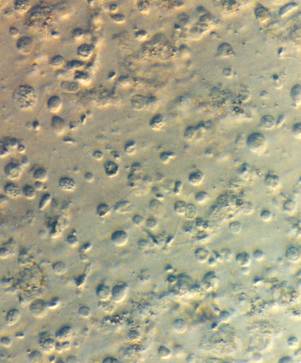
Normal spermatogenesis in testicular sample
Spermatogenesis and precursor cell types
Identifying, correctly, the various cell types representing early stages of spermatogenesis in a fresh preparation is more difficult. When mature spermatozoa are not identified in a testicular preparation, earlier stages may be identified and considered for ICSI, but for most IVF personnel, this practice should be restricted to identification and use of elongating spermatids, where there is a visible, obvious sperm tail, either complete or in the early stages of formation. The use of haploid spermatozoa precursor cells has been considered for use in humans (for review see Yanagimachi, 2005), however it is very difficult to distinguish between haploid round spermatids and diploid round precursor cells, and as such the American Society for Reproductive Medicine and the Society for Assisted Reproduction Practice Committees have stated in a joint report, that ROSNI (or ROSI) should only be considered under approved experimental protocols (ASRM, 2008). For more information on identification of the various cells types present in a testicular preparation, there are two excellent papers that describe the stages of human spermatogenesis, and present photos of both fixed and living cells. Both papers are freely available from the respective journal websites (Johnson et al, 1999, 2001). See also Silber, et al, 1997).
Video with "moving cell" (vasa efferentia or proximal caput epithelial cell) in testicular biopsy: https://youtu.be/CcYypESeEz8
Please leave your comment below.
Embryobit - is a trademark of American College of Embryology